
VanishID Delivers the Missing Control for AI-Fueled Help Desk Impersonation
External Identity Protection mitigates AI-fueled social engineering and credential abuse attacks, auto-firing the right
Press Release Disclaimer: This is a press release distributed through the XPR Media network. It has not been independently verified by our newsroom.
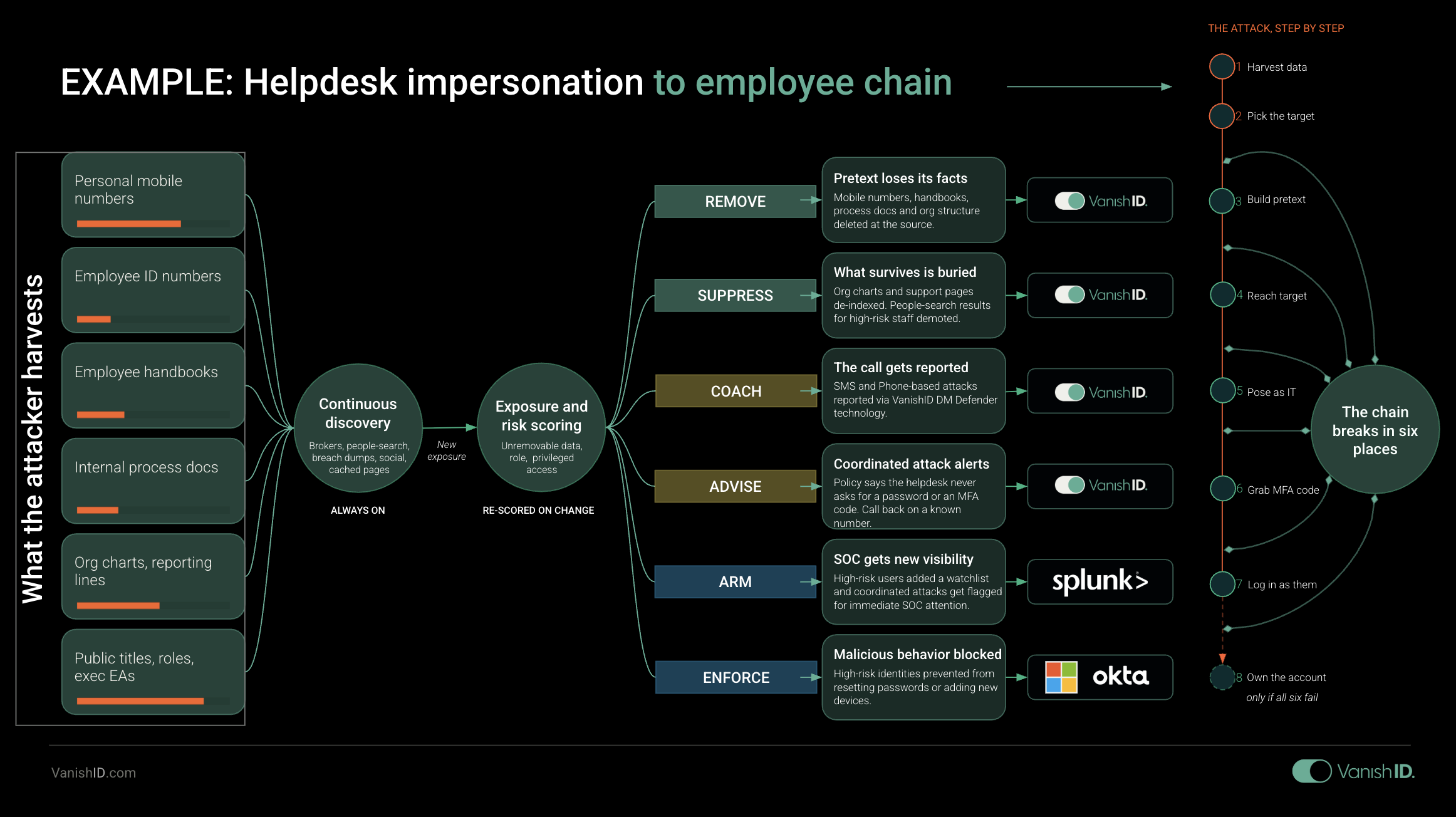

External Identity Protection mitigates AI-fueled social engineering and credential abuse attacks, auto-firing the right countermeasures across six classes
BETHESDA, MD, UNITED STATES, October 15, 2026 /EINPresswire.com/ — VanishID, the external identity security company, today released an automated countermeasure playbook for help desk impersonation inside its External Identity Protection Platform. In this attack, a criminal calls an employee, claims to be the company’s own IT help desk, and leads that employee into enabling access to their work account. The playbook watches for the moment that attack could actually work against a particular person, then fires the countermeasures that shut it down. Nobody on the security team has to spot it or decide anything.
External Identity Protection already mitigates AI-fueled social engineering and credential abuse. VanishID’s new playbook is built for this one attack, because it has become an increasingly common way criminals get in. VanishID pinpointed which countermeasures actually break this attack, wrote them into a playbook, and automated the whole thing. Many countermeasures sit behind it, sorted into six classes, with most running inside the security tools a company already uses.
Help desk social engineering runs in two directions. In one, an attacker calls the service desk impersonating an employee to force a password or MFA reset. Security teams know that pattern as help desk account takeover, and External Identity Protection already covers it. In the other, the attacker impersonates the help desk and calls the employee directly. That second direction is now common enough to warrant a playbook of its own, which is what VanishID is releasing today. Both directions are covered.
In a help desk impersonation attack, an employee receives a call that appears to come from an internal number, making the request seem legitimate. The caller claims there’s a problem with the account and asks the employee to approve a sign-in request or read back a one-time code that just arrived by text. The employee does it, and the criminal is now signed in as that employee, with access to whatever that person can reach.
The call works because the caller sounds like they belong. AI makes that possible. Before dialing, an attacker can leverage AI to pull a personal cell number, job title, manager’s name, org chart position, even a company’s own password-reset instructions, from old data breaches, social media, and sites that collect personal information. That same AI is what turned this from a boutique crime into a volume business; work that used to take a skilled person days per target now runs across an entire staff list in minutes, with a tailored script for each call and, in some cases, a cloned voice. Verizon’s 2026 Data Breach Investigations Report found that 65% of breaches involving AI targeted people and their identities, nearly double the rate across breaches overall.
The tools most companies already own can’t see any of it. Email security never sees the call. Endpoint protection never sees it, because it doesn’t land on a company laptop. The firewall misses it too, since the call never crosses the corporate network. Security teams usually find out afterward, when the logs show what looks like a normal employee doing normal work.
Attacks like this are climbing fast. Break-ins that started with a phone call doubled in the first half of 2026, after rising 134% the year before, according to CrowdStrike’s 2026 Threat Hunting Report. Verizon’s 2026 Data Breach Investigations Report found that 41% of attacks that trick a person now arrive by some route other than email. In financial services, CrowdStrike reported that a criminal group it tracks as MUTANT SPIDER drove the highest volume of intrusions during the reporting period, and likely sold that access to ransomware operators.
How External Identity Protection breaks the chain
VanishID continuously scans the same places attackers and AI look for exposed identity details about an employee. Any new exposure updates that employee’s risk score, and the platform calculates whether a fake help desk call, or any other social engineering or credential abuse attack, could work against that person right now. When it can, the playbook fires automatically. Hundreds of countermeasures sit behind it, grouped into six classes that each work inside tools the security team already runs, from auto-triggered technical controls to targeted employee coaching to removing exposed records. The six classes include:
• ENFORCE auto-triggers compensating technical controls.
• ARM puts exposure context inside the tools the team already watches.
• ADVISE turns risk into security process guidance.
• COACH delivers targeted training at the moment it matters most.
• SUPPRESS hides what cannot be deleted.
• REMOVE deletes exposed records where possible.
Help desk impersonation is one attack in a wider family that runs on exposed identity information, including social engineering and credential abuse. Different attacks call for different countermeasures, which is why this playbook was built specifically for the call, and why it keeps adjusting as exposure changes.
“This call works because everything the attacker needs to sound real is already published somewhere, and AI made assembling it nearly free,” said Matt Polak, VanishID CEO. “That changed the math in the attacker’s favor. Our countermeasures even the playing field. By the time the call reaches your employee, the countermeasures that break this attack have already fired, automatically, without a ticket, an analyst or a decision.”
The help desk impersonation playbook is available now to every External Identity Protection customer, one of many playbooks VanishID is building to protect against the most common social engineering attacks. There’s no software to install. Getting started takes a name and a work email address, and employees don’t have to do anything.
Attackers go after people to get into the company. VanishID’s complimentary AI Exploitability Analysis shows how that would play out against any employee an organization names, ranking the attacks most likely to succeed against that person, showing how AI could turn them into an entry point into the business, and listing the exact countermeasures VanishID would fire to stop each one. Request one at vanishid.com/free-trial/.
About VanishID
VanishID is an external identity security company using agentic AI to identify and neutralize the exposed personal information attackers target. More than 100 organizations, including Fortune 500 enterprises, financial institutions, health systems, and public sector agencies, rely on VanishID. The company is SOC 2 Type II certified and backed by Dell Technologies Capital, Crosslink Capital, Rally Ventures, and other investors. Headquartered in Bethesda, Maryland, VanishID was founded in 2019.
Learn more at vanishid.com.
Marketing
VanishID
Visit us on social media:
LinkedIn
YouTube
X
Legal Disclaimer:
EIN Presswire provides this news content “as is” without warranty of any kind. We do not accept any responsibility or liability
for the accuracy, content, images, videos, licenses, completeness, legality, or reliability of the information contained in this
article. If you have any complaints or copyright issues related to this article, kindly contact the author above.

Media gallery
